Jun 21, 2026
Microcontrollers and Deep Space Exploration
The spacecraft venturing to the edge of our solar system run on some of the most rugged, power-efficient computing ever built. At the heart of these missions are microcontrollers - compact, radiation-hardened processors that command everything from attitude control and propulsion to instrument data collection, often on just a few watts of power.
What makes them remarkable for deep space:
- Radiation tolerance: Hardened designs survive cosmic rays and solar particle events that would corrupt consumer-grade chips.
- Extreme reliability: With round-trip signals taking hours, the hardware must operate autonomously and recover from faults without ground intervention.
- Power efficiency: Every milliwatt counts when you are millions of miles from the Sun relying on RTGs or shrinking solar arrays.
- Longevity: Many of these processors run flawlessly for decades, a testament to conservative, fault-tolerant engineering.
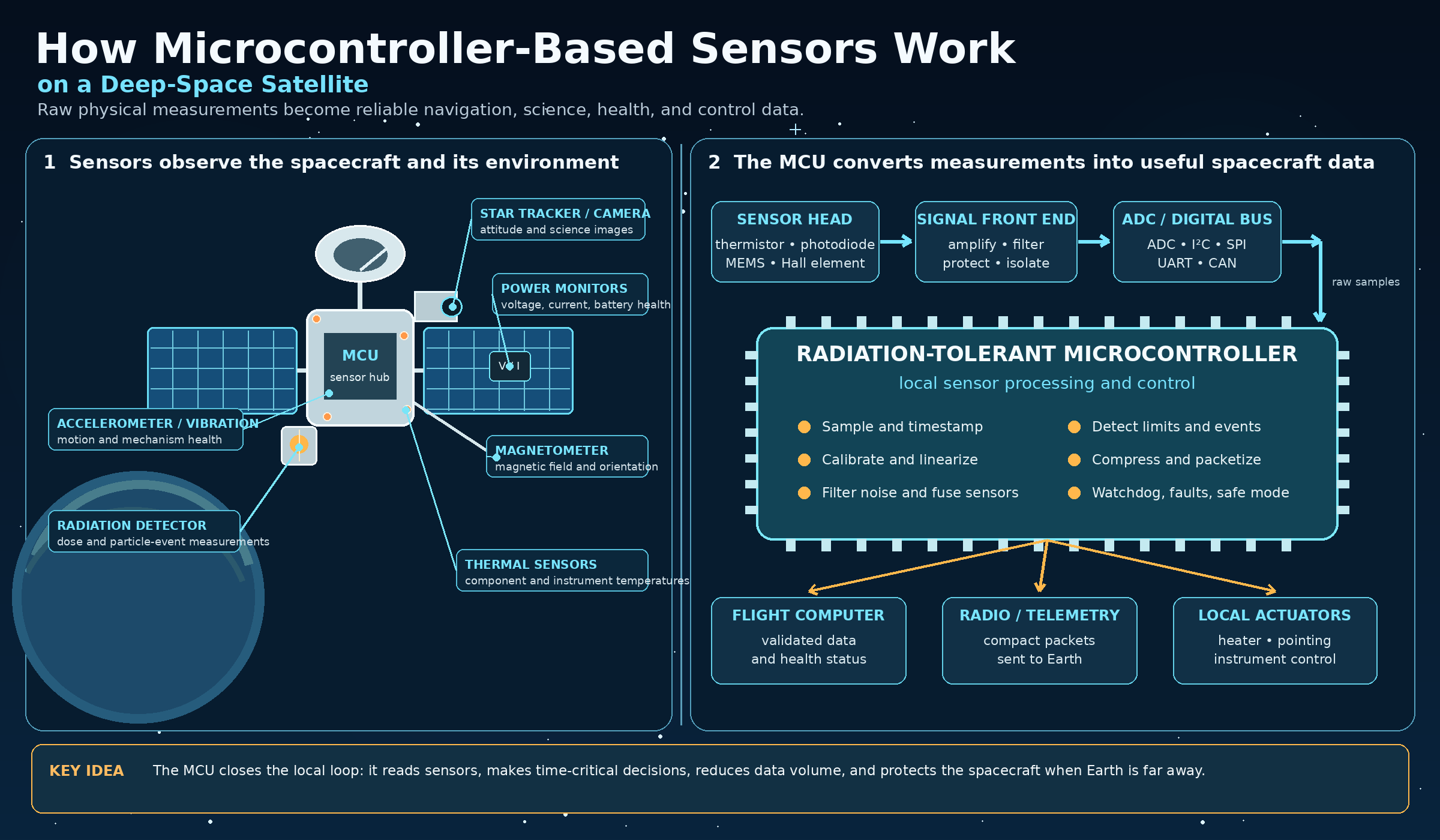
How microcontroller-based sensors actually work (the basics): A sensor's physical element - a thermistor, photodiode, MEMS accelerometer, or Hall-effect device - converts a real-world quantity like temperature, light, motion, or magnetic field into a small analog electrical signal. A signal front end then amplifies, filters, and isolates that signal to clean it up and protect the electronics. An analog-to-digital converter (ADC) samples the conditioned signal and turns it into digital numbers the microcontroller can read over buses such as I2C, SPI, or UART. From there the microcontroller (MCU) does the real work: it timestamps and calibrates each reading, filters out noise, fuses multiple sensors together, detects limit conditions or faults, and compresses and packetizes the data before handing it off to the flight computer, radio, or actuators. In short, the MCU closes the loop locally - sensing, deciding, and acting in real time - which is exactly why it is so critical when a spacecraft is too far from Earth to wait for instructions. t is humbling that proven, deterministic embedded systems - not the fastest silicon - are what carry humanity's instruments into the unknown. The future of exploration depends as much on disciplined low-level engineering as it does on bold mission design.
Reference Hardware
For hands-on experimentation with this class of microcontroller, see the STMicroelectronics NUCLEO-H533RE development board.